
It's no secret that cyber attacks, hacks and breaches are on the increase. The criminals of old never would have thought that such lucrative gains could be gathered while sitting at home behind a keyboard. The threshold of competence required to successfully carry out a breach has significantly lowered in recent years and with the advent of AI assisted attacks, the pace of incidents is increasing.
The incidents held in CSIDB have been collated to produce the following heat-map.
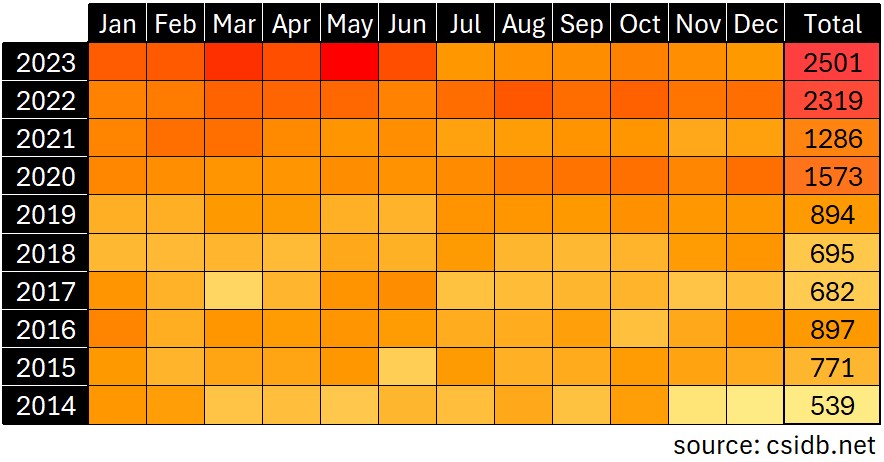
The total number of incidents has been generally increasing over the past decade, with some ups and downs.
- The highest total was last year (2023) with 2,501 incidents.
- 2022 also had a very high number of incidents at 2,319, the second highest in the dataset. So the past two years have seen a significant jump compared to earlier years.
- 2021 was an outlier with a big drop in incidents to 1,286. Not sure of the reason for this sharp one year decline.
- Monthly totals fluctuate quite a bit, but some general patterns emerge. The summer months of June-August tend to be lower. Perhaps the threat actors are spending their ransoms on holidays. The fall and winter months of October-December tend to be higher.
- The monthly distribution is fairly even from January-May, without dramatic highs or lows. March and May tend to be a bit higher though.
- The spike in May 2023 to 483 incidents stands out as unusually high compared to other Mays. This was likely driven by the campaign by the c10p hacker group exploiting a vulnerability in the MOVEit file transfer product which affected many organisations.
In an increasingly interconnected and digital world, the importance of being prepared for potential attacks, whether in the form of cyber threats, unforeseen challenges, or adversarial situations, cannot be overstated. Organizations face a myriad of risks that can disrupt operations, compromise sensitive information, or undermine the ongoing viability of operations.
Resilience in the face of attacks is not merely a reactive response but a proactive mindset that acknowledges the inevitability of challenges and seeks not only to fortify defences but to expect those defences to be breached. Adopting an assume breach mentality, empowers individuals and organizations to navigate adversities with composure, adaptability, and an unwavering commitment to their goals.
The capacity to rebound from setbacks is the essence of resilience. It is a quality that transforms challenges into opportunities for growth and innovation. Resilience is not the absence of adversity but the ability to confront, adapt, and emerge stronger from adversity. It is a counter-force against the debilitating effects of attacks, whether they be in the form of external threats or internal actors.
Being prepared and cultivating resilience is not just a strategic advantage but a necessity in today's dynamic and unpredictable landscape. It instills a mindset of continuous improvement and a commitment to learning from experiences. By embracing the importance of preparedness and resilience, organizations position themselves not only to withstand attacks but to thrive in the face of adversity, emerging more robust and resourceful than ever before.